Jock monteith Salmon Fish Scotland logo
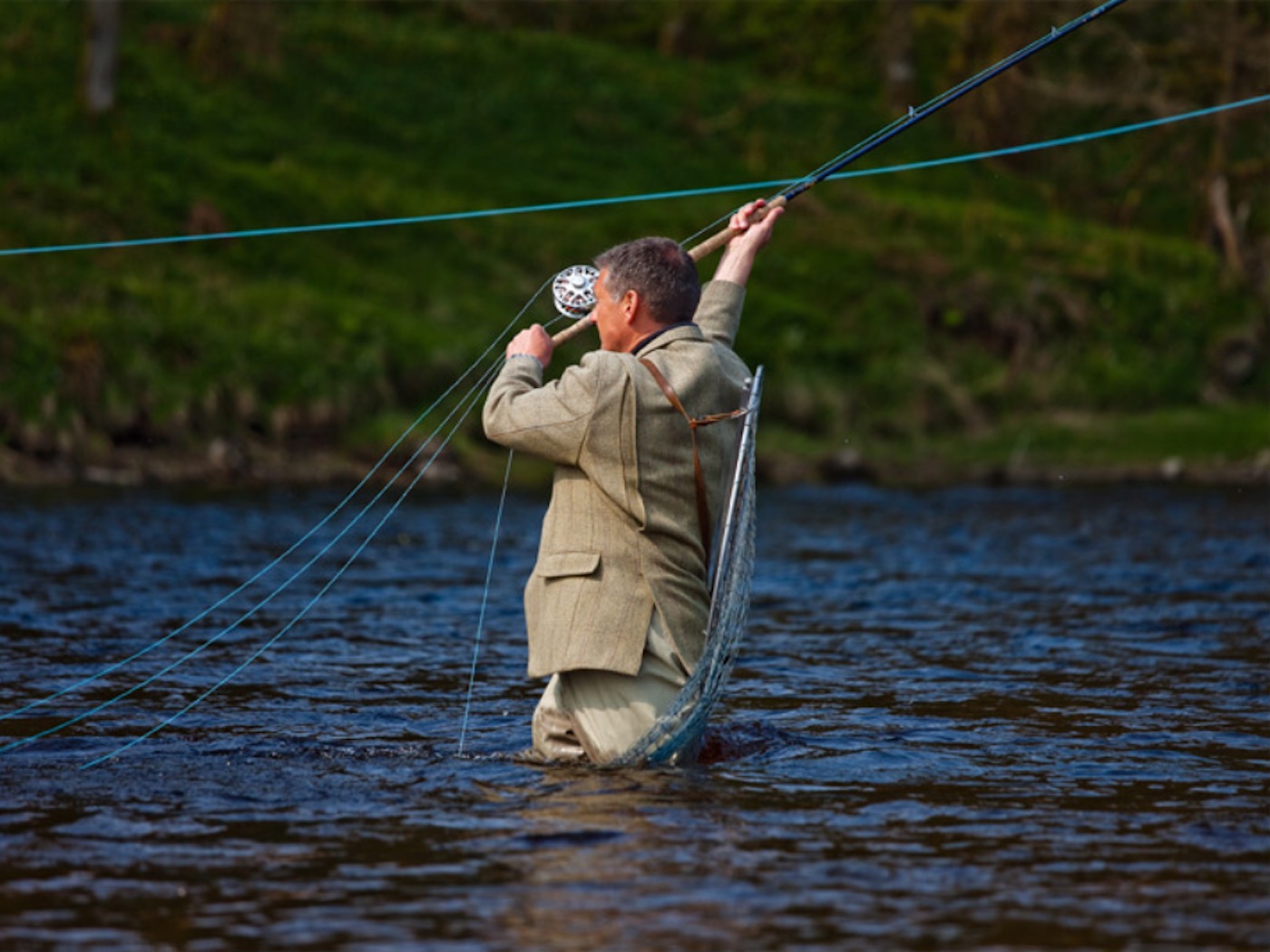
Here's a perfectly executed Spey Cast swing performed by salmon guide Jock Monteith on the River Tay's Kinnaird Beat near Dunkeld. The swing is so important as that's what ultimately creates good D-Loop loading which in turn generates full rod energy for the final power stroke forward delivery. Jock is dressed in his Harris tweed jacket and chest waders.
Here's professional salmon fishing guide Jock Monteith demonstrating the single Spey right hand up cast with his Graham of Menteith tartan kilt and lovat green Tweed jacket. The blue fishing hut across the river is the Newtyle Beat fishing hut near Dunkeld where Jock served as Head Ghillie for a decade. This shot was taken at the neck of the Newtyle Beat's Boil Pool.
Learning to use your left non dominant hand with a Scottish Spey cast opens up a much bigger tactical range for your salmon fishing approach. This salmon fishing tour angler was learning how to do this from his professional salmon fly fishing instructor on the Oak Tree Pool near Meikleour on the River Tay.
This River Dee salmon fly fishing trip guest came all the way from Washington in the USA to test out his brand new Spey rod. Look at the perfect parabolic action of his rod as he powers up the loading for another perfect forward delivery power stroke. This shot was taken by myself as his personal salmon fishing guide on the Invery salmon beat near Banchory in Aberdeenshire.
Here's a salmon fishing holiday guest in the middle of a Spey casting lesson on the River Tummel. The focus was on getting a visual of the anchor point which is the mid section of the cast where the front end of the Spey line briefly touches the surface of the river before being sent across the river. Watching this anchor point touch down assists with the timing of the power stroke as any experienced salmon fly fishing instructor will know.
Here's Jock Monteith amidst a Spey casting lesson on the River Tay under the historic Telford Bridge demonstrating perfect D Loop loading with the single Spey cast. The traditional Spey cast is the most effective and satisfying casts. This photo was taken by local Dunkeld photographer Charlie MacDonald. Jock is wearing his Graham of Menteith tartan kilt while demonstrating Spey cast with his 15ft Monteith salmon fly rod.
This River Tay fly fisher is Spey casting from the traditional Tay salmon fishing boat during late January on the Tay at Dunkeld. If you look closely you'll see the 200 year old Telford Bridge in the distance which is one of the Tay's most historic & beautiful sandstone bridges.

Speycasting Tuition Scotland

By 25th November 2017

In my professional opinion there's way too much fuss made over learning this traditional Scottish salmon fly delivery cast.

The Single or Double Spey casts can be spoken in absolute relevant detailed reference points in under 10 seconds so how can this cast possibly take years to fully master. I'll elaborate on these main points over the next few paragraphs.


The action of your Spey rod is best optimised via proper line loading and if done correctly is virtually effortless like what you see here in this photograph. This salmon fishing trip guest is out on the River Tay practicing his Spey cast power stroke forward delivery near the Perthshire town of Pitlochry.

Speycasting Tuition In Scotland

If you understand the simple logic of the correct hour hand clock face positions that optimise the 'lift & swing' ranges coupled with realising that the further round you bring the mid cast 'anchor point' the more load you'll have for the forward delivery then you're already in the top ten percent who understand this cast.

Here's a guided River Tay salmon fishing guest powering out a nice line with his Spey casting rod on the Catholes salmon fishing beat of the River Tay near Stanley. You can see his fishing buddy slightly upstream and behind him the traditional Tay salmon boat which I used to bring them across to this riverbank as their personal salmon fishing guide and boatman that day.

Perfectling Your Salmon Line Lift

In addition to these points if you realise that a smooth controlled & optimised lift which blends into the swing will keep your fly line perfectly taught through these intitial stages of the cast and under full control for maximum line energy build up. If you 'jolt' the rod forcing it to 'kick back' in the lift or swing it is truly 'game over' before the cast even begins so remember that smoothness & fluency of lift & swing is crucial.

Here's professional salmon fishing guide Jock Monteith demonstrating the single Spey right hand up cast with his Graham of Menteith tartan kilt and lovat green Tweed jacket. The blue fishing hut across the river is the Newtyle Beat fishing hut near Dunkeld where Jock served as Head Ghillie for a decade. This shot was taken at the neck of the Newtyle Beat's Boil Pool.

Maximise Your Salmon Line Rod Ranges

Maximise your lift range all the way smoothly up to a nice high rod position at 11 oclock on the clock face. If you also smoothly bring both hands up while you're lifting smoothly you'll find the line will come to the surface with ease and you'll have negligable water resistance when you change the rod angle as it merges in to the swing. If there's any 'energy kick' in the lift the cast will not work so don't think speed of lift will assist you as it will only have the opposite effect.

Here's professional Scottish salmon guide Jock Monteith our delivering a long fly fishing line across the River Tay near Dunkeld wearing a traditional heavyweight Tweed jacket that hand been handmade by Haggarts of Aberfeldy.

Smooth Yet Assertive Rod Energy

If the swing is conducted with enough smooth yet assertive rod swing energy and your rod has stopped high at 1 oclock a beautiful natural D loop will form automatically which will give you the loading you need to make the forward cast easy. The key to this part of the cast is utilising your periferol vision to judge precisely when to apply the forward power stroke. Do not try to guess the correct moment for the forward delivery and get a visual on it for 100% consistency.

This River Dee salmon fly fishing trip guest came all the way from Washington in the USA to test out his brand new Spey rod. Look at the perfect parabolic action of his rod as he powers up the loading for another perfect forward delivery power stroke. This shot was taken by myself as his personal salmon fishing guide on the Invery salmon beat near Banchory in Aberdeenshire.

Swing The Salmon Spey Rod Smoothly To 1 O'clock

For normal and not distance casting the rod should come round to the 1 oclock rod position. This high rod position will minimise the anchor point so not too much line energy is lost when the forward delivery 'off the water' is applied. The front couple of metres of your fly line should briefly 'kiss the water' for a spit second before you send it away with the forward delivery. This anchor point should be shaped in a straight line and will be if your lift and swing has been smooth enough.

Here's a salmon fishing holiday guest in the middle of a Spey casting lesson on the River Tummel. The focus was on getting a visual of the anchor point which is the mid section of the cast where the front end of the Spey line briefly touches the surface of the river before being sent across the river. Watching this anchor point touch down assists with the timing of the power stroke as any experienced salmon fly fishing instructor will know.

After Lifting Your Line Correctly

After lifting correctly change the rod angle to an outward extended high rod position and swing smoothly and evenly turning your shoulders but keeping your smoothness all the way round making sure again that you keep that smoothness locked in with no 'rod kick' in the swing that will create a hindering pocket of slack in the line's energy build up. 
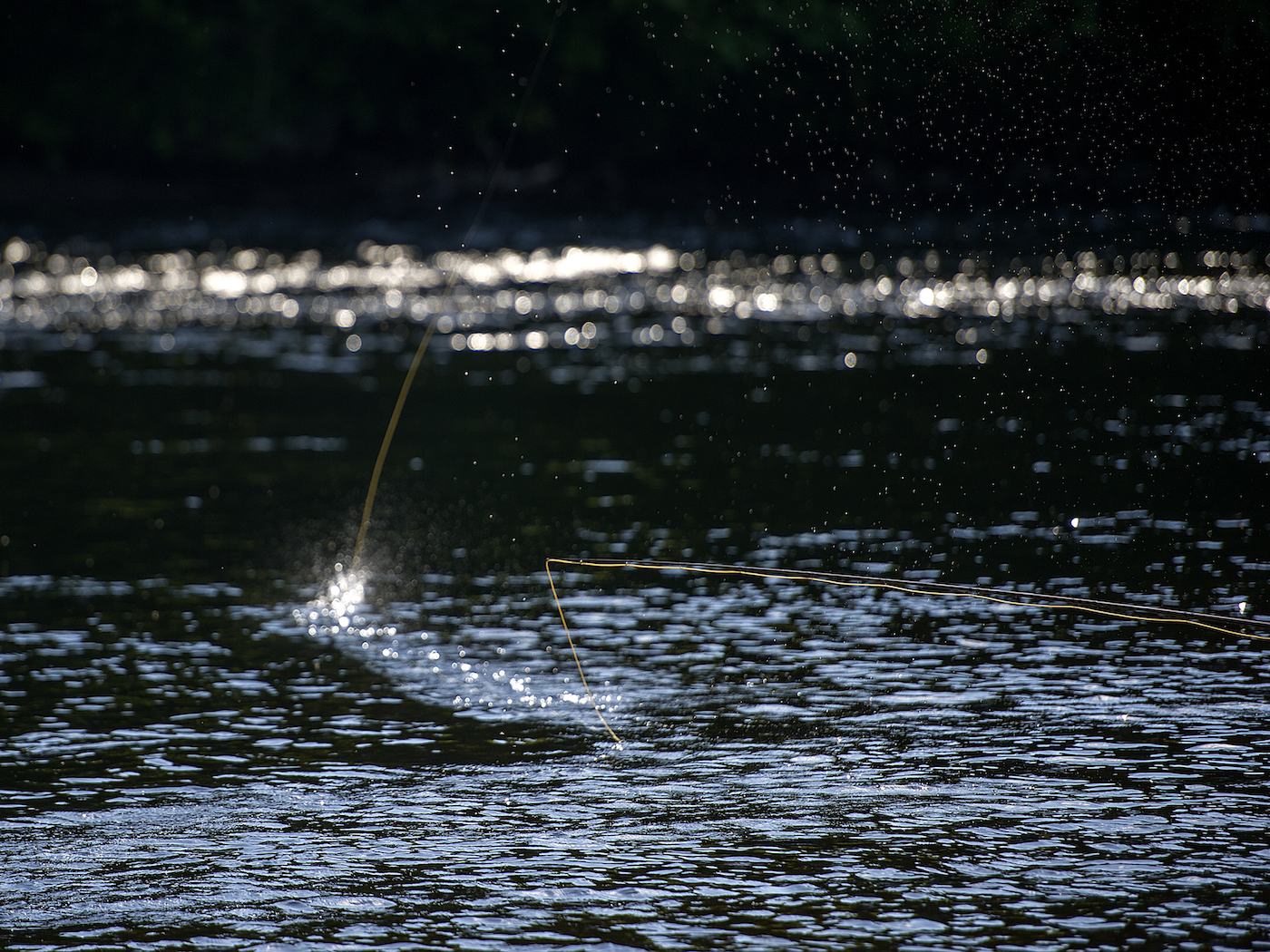
Here's a Spey casting error that can be easily rectified under the supervision of a professional salmon fishing guide. This type of splash down normally occurs when the salmon angler throws the rod at the river on the power stroke instead of stopping the rod high. Our salmon fishing casting lessons can quickly fix this common salmon fly rod casting error.

Watching The Salmon Line Anchor Point

Most Speycaster do not watch the anchor point and fish like 'racehorses with blinkers on'. As you're wading through most salmon pools your height above the water line is constantly making height adjustments so watching the anchor point allows you to precisely 'nail' every forward delivery instead of 'skiffing' a few of them unneccessarily.

Here's a salmon fishing angler mastering the power stroke which is the final part of the 3 stage Spey cast. This shot was taken by myself while serving as a salmon fishing guide at the neck of the Rock Pool on the Lower Tummel Beat of the River Tummel not too far away from the Perthshire town of Pitlochry.

The Forward Fly Rod Power Stroke

On the 'forward power stoke' there should be an almost unseen stop built in high at the 11 oclock forward stroke rod position to set the line off at its optimal trajectory. Don't throw the rod at the river and make sure you get this power release in to let your rod do its job correctly then lower the rod to finish off the cast. There's great satisfaction in delivering this cast effortlessly & correctly and unlike hitting a golf ball the salmon fly is tied on!


More Salmon Fishing Articles