

By Jock Monteith 11th August 2026
Understanding the value of a correct 'logical' line lift at the beginning of the Spey cast is crucial for negating the cast crippling 'water resistance' experienced by an incorrect line lift.
Today I'll elaborate on what maintains this 'ease and smoothness' of cast through the middle section of the cast known as the 'swing' which is crucial for adequate rod loading in the D Loop.

The Spey Rod Angle Change Between The Lift & Swing
Assuming you've fully understood the recent newsletter on 'The Lift' section of the cast as high hands momentarily stop the rod precisely at the top of the lift (at an 11 o'clock rod position) with the rod up to this point 'only' moving parallel to the riverbank. At the top of the lift's 11 o'clock rod position the rod now needs to change to a high outward angle as the line is 'smoothly' yet assertively swung around to the upstream side of your riverbank position. This swing range 'energy' must be smooth and an energised 'mirror image' of either half of the swing so there are no sudden flicks, jirks or gradual swing acceleration added which will destroy the required line energy build up and the remainder of the cast. Keeping the swing 'evenly' energised and completely smooth is the key to perfection assuming your initial 'line lift' has been correct so there's been no 'water resistance' from having too much line still on the water at the top of the lift while merging into the swing.

Separate Your Spey Line Lift From The Swing
Try not to merge the 2 sections of this cast together too quickly as if you over extend the lift past the 11 o'clock stop position you will reduce your swing range which will equate to less loading or having to snatch the remainder of the swing which will have the same negative impact. Open up the rod lift range and the swing range too as the more range you create the more effortless these sections of the cast become. The swing should start at 11 o'clock (across stream clock face) at the top of the lift and finish around to the upstream side of you at a 1 o'clock rod position (upstream clock face). If this is done with sufficient smooth rod swing energy a lovely big D loop of line loading will appear between your 1 o'clock rod stop position and the anchor point where your fly line momentarily touches down on the surface of the river.

Optimise Your Spey Cast Arm Movement Swing Ranges
This also means turning your upper body through the swing and bringing your hands around to the upstream side of you to open up and maximise this swing range. Smoothness of swing is crucial to maintain the nice taught line energy build up from your initial line lift but don't confuse smoothness with slowness as there needs to be a smooth yet 'energised' swing pace applied to bring the rod and line around far enough to an upstream 'anchor point' for optimal loading. This smooth rod swing energy must be 100% evenly distributed as a slow start speeding up mid swing or a fast start slowing down mid swing will not cut the mustard! 100% smooth yet assertive swing energy will maintain your line energy build up.

Don't Dip Your Spey Rod Through The Swing
Don't dip your rod tip through the swing but maintain a high outward rod tip position all the way through the swing. Dipping your rod tip through the swing as you see many Spey casters doing as they try to draw the D loop with the tip of their rod will only produce shallow loading and it's only an assertive smooth rod swing with a consistent high outward pointed rod tip position that will achieve the best loading and nothing else. Make sure however that the rod swing angle is extended high but at an 'outward' angle enough to keep the salmon fly away from you as it passes you through the swing for important safety reasons.

Optimal Positioning Of The Spey Line Anchor Point
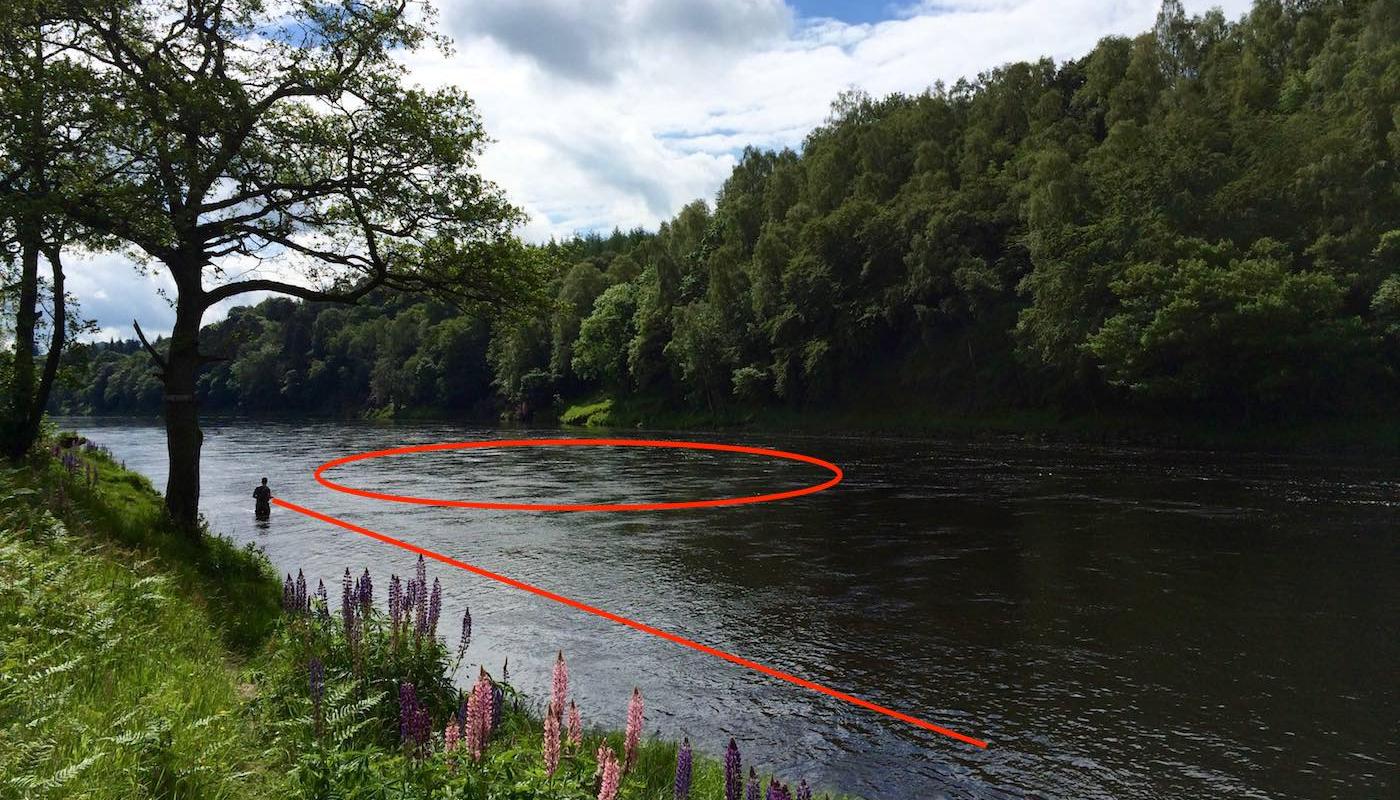
The positioning of the anchor point which is where the front metre of you salmon line briefly touches down on the surface of the river prior to the power stroke is dependent on what type of loading you require for the cast and how much space you have. A perfect lift and smooth controlled swing will completely put you in full control of the anchor point position and if these are done correctly the anchor point should be angled in a perfect straight line at roughly the optimal angle the line has to be delivered from the water at. If your anchor point isn't creating this optimal shape on the river's surface for a slick departure it is a guarantee that there is an error occurring in your lift or swing. Even with a bulkier slightly more difficult to control shooting head or Skagit line a smooth swing will lay the line down as described above. View the anchor point positioning as pulling back on a bow as the further you pull it back the more power you are going to create. There's no right or wrong as to the exact positioning of the anchor point on the surface of the river as long as it's approximately one rod length away from your shoulder. That area is a safe area where an unexpected gust of wind is highly unlikely to blow the fly into you as you apply the power stroke. In saying that and even for highly experienced Spey casters suitable eye protection should be worn at all times.

Take A Visual On The Anchor Point
Most salmon anglers fish like 'racehorses with blinkers on' but if you wish to get your timing 'off the water' precisely correct as the line touches down and your hands are round at the side of you with the rod held high at a 1 o'clock rod position and a big D loop of line loading has naturally formed it is advantageous to watch your anchor point. As you fish down through most salmon pools your height above the waterline will usually be changing & adjusting frequently (which often goes unnoticed) which means so should the timing of your power stroke delivery. To get this absolutely right use your peripheral vision to tell you exactly when to apply the power stroke instead of trying to guess it or rely on a sense of timing which may not be sharp enough yet if you're new to the cast. The anchor point only needs to be kissing the water for a brief second when the time will be right to send it away. Watch the anchor point then turn your vision onto the target area after you've applied the forward delivery power is the most logical procedure and don't get caught up with 'target fever' as casting distance will take care of itself if your timing 'off the water' is perfect. A detailed breakdown of the final stage of the Spey cast known as The 'Power Stroke' will follow in tomorrow's news article.